Dragonfolk include the proud dragonborn, and the puny kobolds.
Dragonborn
Born of dragons, as their name proclaims, the dragonborn walk proudly through a world that greets them with fearful incomprehension. Shaped by draconic gods or the dragons themselves, dragonborn originally hatched from dragon eggs as a unique folk, combining the best attributes of dragons and humanoids. Some dragonborn are faithful servants to true dragons, others form the ranks of soldiers in great wars, and still others find themselves adrift, with no clear calling in life.
Proud Dragon Kin
Dragonborn look very much like dragons standing erect in humanoid form, though they lack wings or a tail. The first dragonborn had scales of vibrant hues matching the colors of their dragon kin, but generations of interbreeding have created a more uniform appearance.
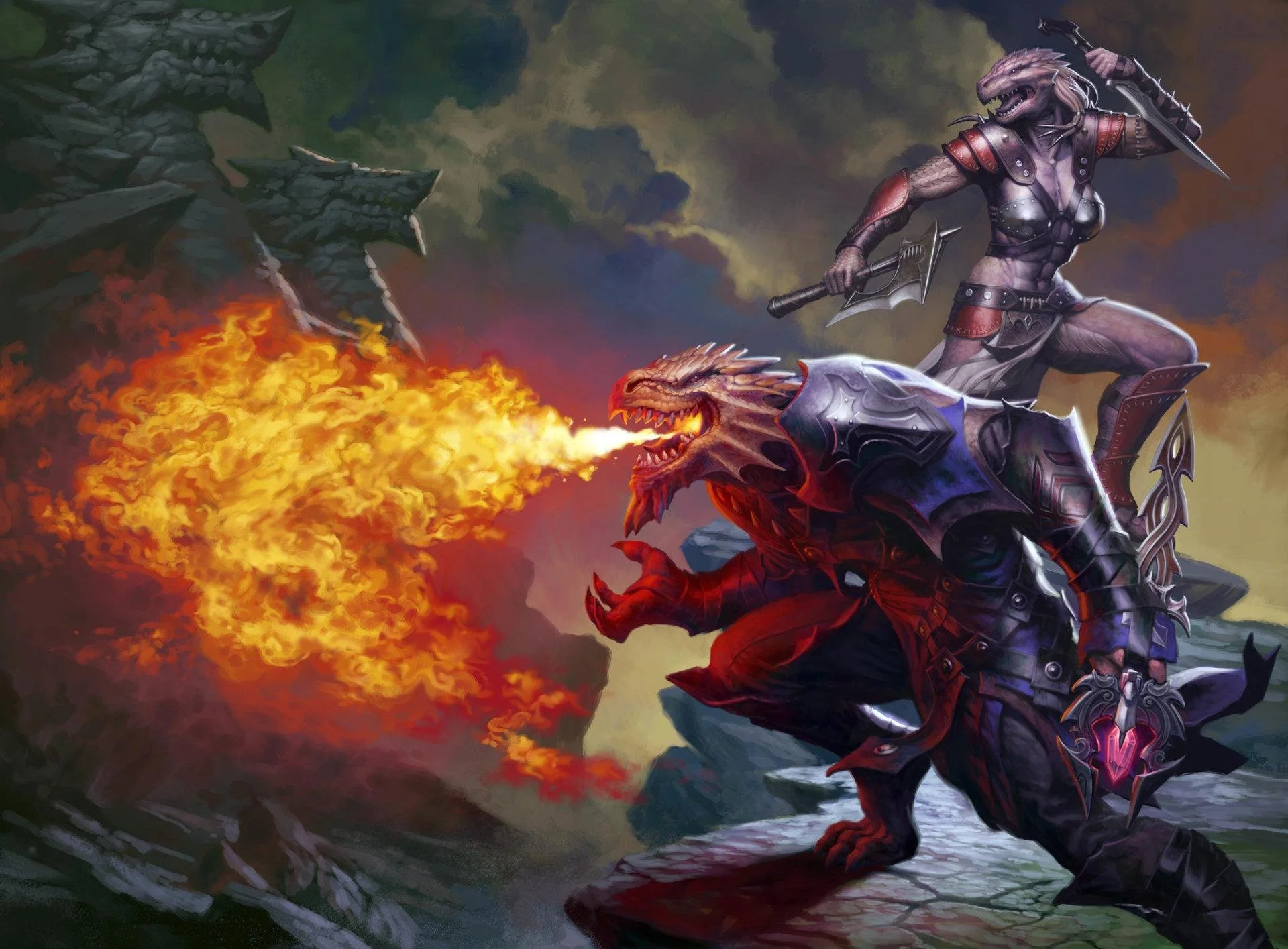
Their small, fine scales are usually brass or bronze in color, sometimes ranging to scarlet, rust, gold, or copper-green. They are tall and strongly built, often standing close to 6½ feet tall and weighing 300 pounds or more. Their hands and feet are strong talon-like claws with three fingers and a thumb on each hand.
The blood of a particular type of dragon runs very strong through some dragonborn clans. These dragonborn often boast scales that more closely match those of their dragon ancestor—bright red, green, blue, or white, lustrous black, or gleaming metallic gold, silver, brass, copper, or bronze.
Self-Sufficient Clans
To any dragonborn, the clan is more important than life itself. Dragonborn owe their devotion and respect to their clan above all else, even the gods. Each dragonborn’s conduct reflects on the honor of his or her clan, and bringing dishonor to the clan can result in expulsion and exile. Each dragonborn knows his or her station and duties within the clan, and honor demands maintaining the bounds of that position.
A continual drive for self-improvement reflects the self-sufficiency of the folk as a whole. Dragonborn value skill and excellence in all endeavors. They hate to fail, and they push them selves to extreme efforts before they give up on something. A dragonborn holds mastery of a particular skill as a lifetime goal. Members of other folk who share the same commitment find it easy to earn the respect of a dragonborn.
Though all dragonborn strive to be self-sufficient, they recognize that help is sometimes needed in difficult situations. But the best source for such help is the clan, and when a clan needs help, it turns to another dragonborn clan before seeking aid from other folk — or even from the gods.
Dragonborn Names
Dragonborn have personal names given at birth, but they put their clan names first as a mark of honor. A childhood name or nickname is often used among clutchmates as a descriptive term or a term of endearment. The name might recall an event or center on a habit.
-
Male Names: Arjhan, Balasar, Bharash, Donaar, Ghesh, Heskan, Kriv, Medrash, Mehen, Nadarr, Pandjed, Patrin, Rhogar, Shamash, Shedinn, Tarhun, Torinn
-
Female Names: Akra, Biri, Daar, Farideh, Harann, Flavilar, Jheri, Kava, Korinn, Mishann, Nala, Perra, Raiann, Sora, Surina, Thava, Uadjit
-
Childhood Names: Climber, Earbender, Leaper, Pious, Shieldbiter, Zealous
-
Clan Names: Clethtinthiallor, Daardendrian, Delmirev, Drachedandion, Fenkenkabradon, Kepeshkmolik, Kerrhylon, Kimbatuul, Linxakasendalor, Myastan, Nemmonis, Norixius, Ophinshtalajiir, Prexijandilin, Shestendeliath, Turnuroth, Verthisathurgiesh, Yarjerit
Dragonborn Traits
Your draconic heritage manifests in a variety of traits you share with other dragonborn.
-
Ability Scores. Your Strength ability score, both current and maximum, increases by 2.
-
Age. Young dragonborn grow quickly. They walk hours after hatching, attain the size and development of a 10-year-old human child by the age of 3, and reach adulthood by 15. They live to be around 80.
-
Alignment. Dragonborn tend to extremes, making a conscious choice for one side or the other in the cosmic war between good and evil (represented by Bahamut and Tiamat, respectively). Most dragonborn are good, but those who side with Tiamat can be terrible villains.
-
Languages. You understand Common and Draconic. Draconic is thought to be one of the oldest languages and is often used in the study of magic. The language sounds harsh to most other creatures and includes numerous hard consonants and sibilants.
-
Size. Dragonborn are taller and heavier than humans, standing well over 6 feet tall and averaging almost 250 pounds. Your size is Medium.
-
Speed. Your base speed is 30 feet.
Draconic Ancestry
Choose one type of dragon from the Draconic Ancestry table (or roll randomly). Your breath weapon and damage resistance are determined by the dragon type, as shown in the table.
-
Draconic Ancestry
1d10 Dragon Damage Type Breath Weapon 1 Black Acid 5 by 30 ft. line (Dex. save) 2 Blue Lightning 5 by 30 ft. line (Dex. save) 3 Brass Fire 5 by 30 ft. line (Dex. save) 4 Bronze Lightning 5 by 30 ft. line (Dex. save) 5 Copper Acid 5 by 30 ft. line (Dex. save) 6 Gold Fire 15 ft. cone (Dex. save) 7 Green Poison 15 ft. cone (Con. save) 8 Red Fire 15 ft. cone (Dex. save) 9 Silver Cold 15 ft. cone (Con. save) 10 White Cold 15 ft. cone (Con. save) -
Breath Weapon. You can use an action to exhale destructive energy. Your draconic ancestry determines the size, shape, and damage type of the exhalation.
When you use your breath weapon, each creature in the area of the exhalation must make a saving throw, the type of which is determined by your draconic ancestry. The DC for this saving throw equals 8 + your Constitution modifier + your proficiency bonus. A creature takes 2d6 damage on a failed save, and half as much damage on a successful one. The damage increases to 3d6 at 6th level, 4d6 at 11th level, and 5d6 at 16th level.
Once you use this trait, you can’t use it again until you finish a long rest.
Damage Resistance. You have resistance to the damage type associated with your draconic ancestry.
Varied Lineage. You may select a dragonborn exclusive feat, described later in this document.
Other features
Roll an additional feature to personalize your dragonborn.
d30 Features Breath weapon 1 I have poor control over my breath weapon, and when I am agitated my nostrils and mouth crackle with lightning/exude a green gas/smoke like chimneys/ drip green acid/breath puffs of frosty white air. 2 My breath weapon is always accompanied by a horrific, sickly sweet stench. 3 My breath weapon is unusually colored (blue fire, red acid, green lightning, etc). 4 My breath weapon is incredibly uncomfortable, even painful, like puking. A few dry heaves beforehand, with a bit of tears and snot afterwards. Eyes 5 My eyes gleam red while in combat. 6 I have a set of normal eyelids, and a thin, almost transparent pair underneath that moves in a perpendicular direction to the other two. 7 I have two pupils, with different colored irises. Head 8 I have long overly curled horns. 9 I have a crest of multicolored feathers atop my head, resembling a hairdo. 10 I have a frill running up the snout, head, and the back of the neck. 11 I have two long, spined and membranous ears. Scales 12 I have several scales missing and a long gash running along my face. 13 My scales are prismatic. 14 I have traces of another color (for example, little splotches of black scales on a green dragonborn). 15 My scales are sleek and uniform, like a snake. d30 Features (cont.) 16 My scales are incredibly uneven. Some are huge, others are tiny. This isn’t uncomfortable, just making interesting patterns on my skin. Speech 17 I slur all my S’s into ‘sh’ sounds. 18 I often switch into speaking Draconic and have to catch myself. 19 I am overly formal and insist to call everyone by their full name and title at all times. Wings 20 I have two small bony nubs at my shoulder blades - vestigial wings. 21 I have flaps of skin under my armpits, almost like wings but they don’t do anything. 22 I have weak and useless vestigial wings coming out of my shoulders that I try to keep hidden. Other 23 I have spines that stick out from every joint. 24 I have 2 inch retractable nail/talons on my fingers and toes. 25 I have tail spikes like a stegosaurus. 26 When sleeping, I exhale harmless clouds of smoke from my nostrils. 27 I take great pride in my claws, and have intricate designs painted on them. 28-30Roll twice more on this table
Dragonborn Class Options
Dragonfolk approach some classes is a bit differently than other folk. When you select a class, it is modified as follows:
-
Alchemist
Most dragonfolk never even come into contact with the alchemical crafts unless they live in or near a human city. However, those who have and chosen this as their lifetime goal usually turn out to be excellent alchemists.
Whenever the Alchemist class description calls for your Intelligence modifier, you can increase that modifier by 3, up to a maximum equal to your proficiency bonus.
-
Barbarian
Raging dragonfolk often give in completely to their draconic rage. While raging, you can bite, rip and tear as if you had a natural weapon dealing 1d4 piercing or slashing damage. If attacking only with natural weapons while raging, you may make an additional attack using a bonus action as if wielding an off-hand weapon.
In addition, while raging, you can spend 10 Fury to use your breath weapon without spending its use, even if you have no uses remaining. If you do, add your rage damage bonus to the damage it deals.
-
Bard
Bards are a poor fit for dragonfolk for two main reasons. First, the bard class is very much jack of all trades, while dragonborn sees it as very important to be focused on one thing. Second, the bard profession is seen as mostly useless, with no practical use.
-
Cavalier
Dragonfolk do not usually become cavaliers. Mounts are often not comfortable with dragons on their backs. However, there are dragonriders, who ride drakes into battle. (Not suitable for player characters.)
-
Cleric
Dragonfolk sees it as a weakness to rely on the gods. There are clerics in dragonfolk clans, but their role is not so much religious, as it is to keep the traditions, stories and laws.
If you are a Cleric following Bahamut or Tiamat (and one of their domains), whenever the Cleric class description calls for your Wisdom modifier, you may use your proficiency bonus instead.
-
Cursed
Dragonfolk cannot become lycanthropes.
-
Druid
Druids are uncommon among dragonfolk. Why would anyone want to change their form when it is perfect already?
-
Feyblood
You can select to be one of the rare faerie dragons. You make this choice at first level, and can’t change it later.
The Colors of Age. A faerie dragon’s scales change hue as it ages, moving through all the colors of the rainbow.
Color Age Red 5 years or less Orange 6–10 years Yellow 11–20 years Green 21–30 years Blue 31–40 years Indigo 41–50 years Violet 51 years or more Euphoria breath. Your breath weapon changes to a 15 ft cone of gas. Creatures within the cloud must succeed at a Wisdom save, or be confused for one minute. A creature can repeat the saving throw at the end of each of its turns, ending the effect on itself on a success.
Innate Spellcasting. You learn the dancing lights and minor illusion cantrips.
-
Fighter
The natural traits of dragonfolk, such as thick scales or draconic ferocity, make them fearsome fighters.
Whenever the Fighter class description calls for your Strength modifier you may use your proficiency bonus instead. This also applies to attack and damage rolls using this ability.
In addition, when calculating AC and initiative, rather than the usual modifier, you may use your proficiency bonus instead.
-
Inquisitor
Dragonfolk do not put much value in religion, so the inquisitor role is mostly non-existent. The only time you would see a dragonfolk inquisitor would be if the individual was raised by humans.
-
Paladin
Paladins are embodiments of the heroic ideals for their folk. As the most common folk that becomes paladins are humans, the archetypal behaviour of paladins is the ideal for humans.
This often confuses people when they first meet a dragonfolk paladin, as they follow the ideals of their folk, which might be similar, but can also be completely different from humans.
If you are a Paladin devoted to the ideals of Bahamut, whenever the Paladin class description calls for your Strength or Charisma ability modifier, you can increase that modifier by 3, up to a maximum equal to your proficiency bonus. This also applies to attack and damage rolls.
-
Professional
Dragonfolk are well suited to be professionals as they have a natural desire for self-improvement and excellence in a narrow field. However, generally dragonfolk tend to prefer and value the more practical fields, like the candlemaker, cook, smith or forester.
If belonging to a more practical field, whenever the Professional class description calls for your Wisdom modifier, you can increase that modifier by 3, up to a maximum equal to your proficiency bonus.
-
Ranger
The ranger is the epitome of self-sufficiency.
Whenever the Ranger class description calls for your Wisdom modifier, you may use your proficiency bonus instead. In addition, you can use the same modifier for attack and damage rolls instead of Strength or Dexterity. You make this choice at first level, and can’t change it later.
-
Rogue
Dragonfolk are really not built for stealth and subterfuge. However, sometimes the dragons’ famed lust for gold endures in a dragonborn, who suffer the inescapable allure of treasure.
As a first level rogue, you can choose to gain the following package of traits:
Hoard-Keeper. At 3rd level, you learn the alarm spell. You can cast it once without expending a spell slot, and you regain the ability to do so when you finish a long rest. At 5th level, you learn the locate object spell. You can cast it once without expending a spell slot, and you regain the ability to do so when you finish a long rest. Intelligence is your spellcasting ability for these spells.
Treasure Sense. You can supernaturally sense gold, gems, and other treasures within 30 ft and through most barriers, but your senses are blocked by 1 ft of stone, 1 inch of common metal, a thin sheet of lead or 3 ft of wood or dirt. You can use this trait to detect the presence of magical items, but not identify them or their abilities.
Flaw. My greed for gold and gemstones has a nearly religious fervor.
-
Sorcerer
Sorcerers are just as rare and varied as within other folk.
Whenever the Sorcerer class description calls for your Charisma modifier, you may use your proficiency bonus instead.
-
Swashbuckler
Even though dragonfolk might seem unlikely to become swashbucklers, they do appreciate the skill required to survive combat without armor. Dragonfolk that choose to take the path of swashbuckling tend to more clever than calculating.
Whenever the Swashbuckler class description calls for your Intelligence modifier, you may use your proficiency bonus instead.
-
Warlock
If you are a Warlock with an ancient dragon patron, then whenever the Warlock class description calls for your Intelligence modifier, you may use your proficiency bonus instead.
-
Wizard
Dragonfolk see the wizard as any other professional, and approach it with the same focus as they would any other life goal.
Whenever the Wizard class description calls for your Intelligence modifier, you may use your proficiency bonus instead. You may only do this if you are literate.
-
Kobold
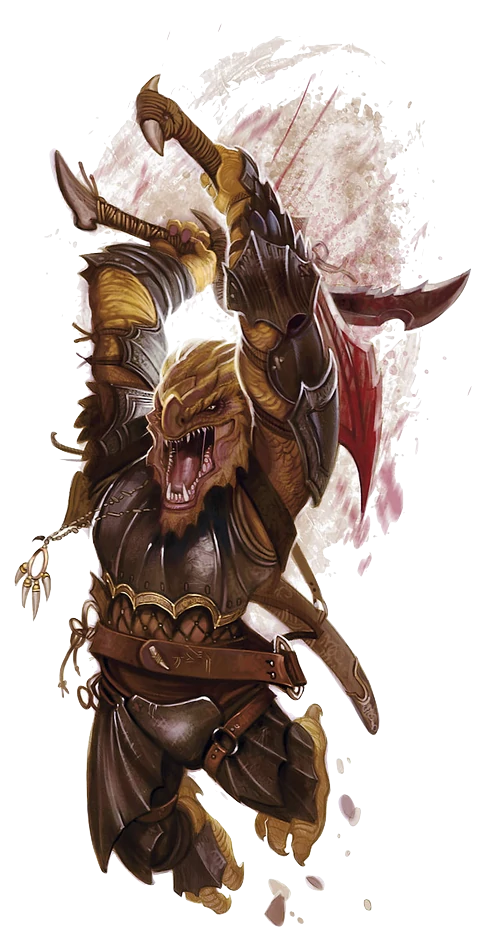
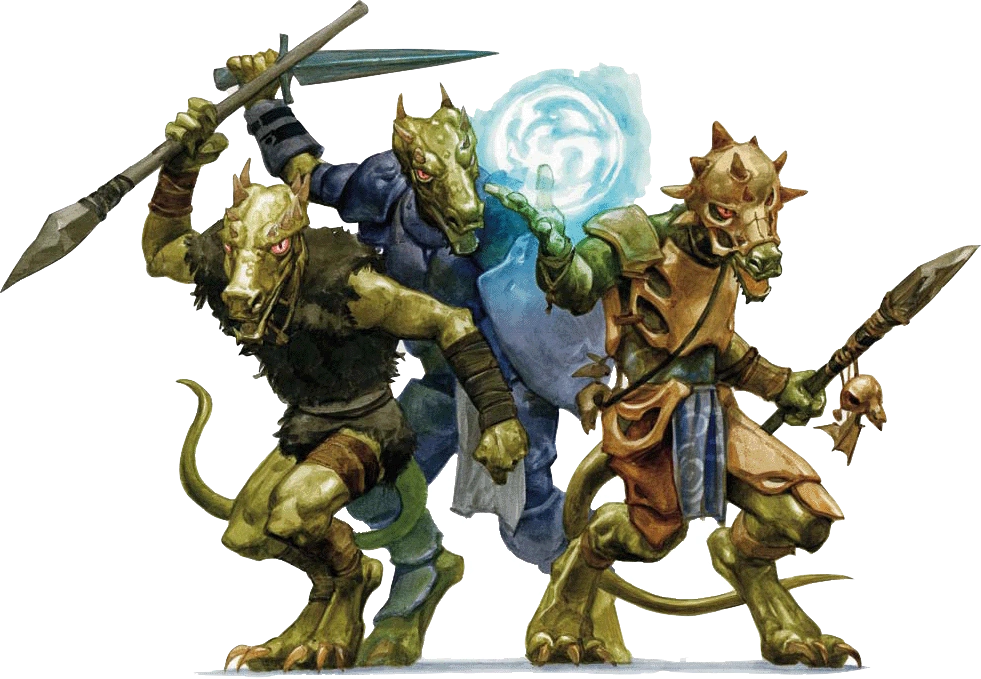
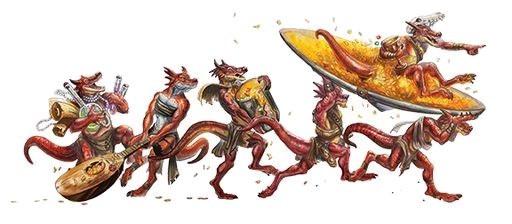
Kobolds are often dismissed as cowardly, foolish, and weak, but these little reptilian creatures are clever with their hands, and viciously work together in order to overcome their physical limitations. Kobold are short in stature, despite the draconic blood running in their veins, with the tallest of them barely reaching 3 feet and weighing no more than 35 pounds. Because of their small size, kobold often have to adopt unorthodox means of achieving victory. This usually leads to traps, which kobold are well known for crafting.
Unlike the true dragons they worship, kobolds don’t have set colors that reflect certain personality traits. Whole tribes usually are the same one or two colors, and the color of a kobold has no bearing on its abilities or skill set. Kobolds display many of the traits that true dragons display, and are often either proud, or vain (or both).
“Kobolds are a lot less cute when they learn to cast fireballs.”
– Volo
A kobold can be fooled with smooth words or a quick wit, but when the kobold figures out it has been tricked, it remembers the affront. And when possible will retaliate against that person somehow, even if merely in a petty way. Though they are far less grudgeful against draconic folk, feeling that they act so because they must prove their worth.
A small package of greatness
Due to their small size, many kobold often feel that there’s safety in numbers. As such they rarely strike out on their own, unless it’s a mission of great importance or they are serving or proving themselves to a dragon.
While kobolds prefer to run away from a fight, they know that there is greatness within them and are proud that they were chosen to be the blood-kin of dragons. Despite this, a typical kobold acknowledges its weakness in the face of a hostile world. However, a kobold finds satisfaction in its work, the survival of its tribe, and the knowledge that it shares a heritage with mighty dragons.
Worship of dragons
Kobolds are renowned for their worship of dragons, in which case they cast aside any pride they have and willingly and proudly serve such mighty creatures without a thought of treason. If the dragon expresses cruelty, they will tolerate it or simply go away instead of seeking revenge. They even display actual acts of courage while within their service. Strangely, they have the same sentiment towards dragonborn and half dragons, whom they consider to be dragons.
This often leads to the annoyance of dragonborn, many of whom hold resentment towards dragons for past slavery. However, their obsessive loyalty and devotion, and their skill at handling the sewage of draconic communities, causes the other draconic folk to tolerate their presence. And those that are able to put their pride aside acknowledge that more than one draconic community has been saved by using the kobolds overwhelming numbers and unorthodox way of fighting.
Natural miners
Kobolds are naturally skilled at tunneling. Similar to dwarves, they have a near instinctive sense of what sections of stone or earth are strong or weak, are bearing a load or are safe to excavate, or are likely to contain minerals or offer access to water. This ability enables them to fashion secure homes in places where other creatures wouldn’t feel safe.
Kobolds take advantage of their size by creating small diameter tunnels that they can easily pass through, but that require larger creatures to hunch or even crawl to make progress.
Kobold Names
Kobold names are derived from the Draconic tongue and usually relate to a characteristic of the owner, such as scale color, distinctive body parts, or typical behavior. For example, “Red Foot, “White Claw” and “Scurry” are Common translations of often-used names. A kobold might change its name when it becomes an adult, or add additional words and syllables after important events such as completing its first hunt, laying its first egg, or surviving its first battle.
Because kobolds can change sex to suit a tribe’s needs, they don’t differentiate between male or female names.
Kobold Names: Arix, Eks, Galax, Garu, Hagnar, Hox, Irtos, Kashak, Meepo, Molo, Ohsoss, Rotom, Sagin, Sik, Sniv, Taklak, Tes, Urak, Varn.
Kobold Traits
As a kobold, you gain the following traits:
-
Ability Scores.
– Strength is reduced by 4.
– Wisdom is reduced by 2.
– Dexterity is increased by 2.
These ability score changes apply to both current and maximum. -
Age. Kobolds reach adulthood at age 6 and can live up to 120 years, but rarely do so. Those that live within or near draconic communities tend to live longer.
-
Alignment. Kobolds rely on the strength of their group, which makes them tend toward law.
-
Languages. You understand Common and Draconic.
-
Size. Kobold are between 2 and 4 feet tall and weigh between 25 and 50 pounds. Your size is Small.
-
Speed. Your base walking speed is 25 ft.
-
Burrower. As an action while holding a pickaxe, you can grant yourself a burrow speed of 5 ft through non-rock earth until the end of your turn.
-
Center of Attention. As an action you can distract nearby foes. This can be done by cowering pathetically, shrieking furiously, boasting arrogantly or through other means. Until the end of your next turn, your allies gain advantage on attack rolls against enemies within 10 ft of you that can see you.
Once you use this trait, you can’t use it again until you finish a short rest.
-
Fleeting Courage. When you succeed on a saving throw, you have advantage on the next attack roll or saving throw you make before the end of your next turn.
-
Pack Tactics. You have advantage on an attack roll against a creature if at least one of your allies is adjacent to the creature and the ally isn’t incapacitated. You can only benefit from this trait once on each of your own turns.
-
Skilled Trapper. Add Craft - Trapmaking to your class skills if not already there, and gain 1 skill point to spend on that skill.
-
Low-light Vision. Living underground, you can see in dim light as if it were bright light, and an additional 60 ft into darkness as if it were dim light.
-
Optional
Instead of Low-light Vision, you may select to have both the Darkvision and Sunlight Sensitivity traits.
Darkvision. For 30 ft around you, you can see in darkness as if it were dim light. You can’t discern color in darkness, only shades of grey.
Sunlight Sensitivity. You have disadvantage on attack rolls and Perception checks that rely on sight when you, the target of the attack, or whatever you are trying to perceive is in direct sunlight.
Kobold Class Options
Kobolds approach some classes is a bit differently than other folk. When you select a class, it is modified as follows:
-
Alchemist
Kobolds are clever and cunning, and have a natural aptitude towards the practical applications of alchemy.
Whenever the Alchemist class description calls for your Intelligence modifier, you may use your proficiency bonus instead.
-
Barbarian
Kobolds may be small and weak, but when cornered, they defend themselves in a flurry of draconic rage, biting and tearing with furious rage.
While raging, you can bite, rip and tear as if you had natural weapons (finesse) dealing 1d4 piercing or slashing damage. If attacking only with natural weapons while raging, you can make an additional attack when you take the Attack action. Additionally, you may make an attack using a bonus action as if wielding an off-hand weapon.
You can add your rage damage bonus to both Strength and Dexterity attacks.
-
Bard
Kobolds only use very primitive instruments, so the kobold bards mostly play some type of drum, or sing. However, their singing sounds terrible to most people, similar to cats in heat.
-
Cavalier
The cavalier class is more common than one would think among the kobolds. They are often seen riding on large lizards or drakes.
Whenever the Cavalier class description calls for your Strength or Charisma ability modifier, you can increase that modifier by 3, up to a maximum equal to your proficiency bonus. This also applies to attack and damage rolls.
-
Cleric
Kobolds worship dragons as their gods. This means that the cleric class does not exist, as there is no divine power to grant spells and powers. Instead the religious role of cleric is filled with sorcerers and warlocks who believe their power is granted by their dragon “gods”.
-
Cursed
Dragonfolk cannot become lycanthropes.
You may choose Wisdom or Charisma as your spellcasting ability instead of Intelligence.
-
Druid
No change.
-
Feyblood
A kobold affect by fey magic can use their faerie dust in a different way. As an action you can spend a use of faerie dust to spread it in a 10 ft radius around you. Creatures within the cloud must succeed at a Wisdom save against you spellcasting DC or be confused for one minute. A creature can repeat the saving throw at the end of each of its turns, ending the effect on itself on a success.
-
Fighter
Kobold fighters may can add the following fighting style to their selection of fighting styles.
And then I did anyway…
They told you it was too big and that you shouldn’t train with it. And then you did anyway. Through perseverance, you have managed to overcome your size. Choose one weapon with which you are proficient and that has the Heavy property. You can use that weapon without disadvantage.
-
Inquisitor
The religious practices of kobolds mostly ignore matters outside their own communities, so the inquisitor role does not really exist.
-
Paladin
Paladins are very rare but they do exist among the kobold, and are then embodiments of the heroic ideals for their folk. This often confuses people when they first meet a kobold paladin, as they expect a paladin to follow the human ideals.
Whenever the Paladin class description calls for your Charisma modifier, you may use your proficiency bonus instead.
In addition you can add the fighting style from the fighter entry to your selection of fighting styles.
-
Professional
Kobolds are clever and can easily pick up the professional class. However, like any other more primitive folk they tend to prefer and value the more practical fields, like the candlemaker, cook, smith or forester.
If belonging to a more practical field, whenever the Professional class description calls for your Wisdom modifier, you may instead your proficiency bonus.
-
Ranger
As a kobold ranger you have access to the Trickster conclave.
Whenever the Ranger class description calls for your Wisdom modifier, you may use your proficiency bonus instead. In addition, you can use the same modifier for attack and damage rolls instead of Strength or Dexterity. You make this choice at first level, and can’t change it later.
You can add the fighting style from the fighter entry to your selection of fighting styles.
-
Rogue
Kobolds are ideal rogues. When using your Dexterity modifier to calculate AC, attack bonus or attack damage, you can increase that modifier by 3 or by your proficiency bonus.
In addition, when using sneak attack, you can opt to not use all your sneak attack dice. For each die you did not use, you gain a +1 to AC until the start of your next turn. You may opt to use all sneak attack dice in this manner.
-
Sorcerer
Sorcerers are just as rare and varied as within other folk.
Whenever the Sorcerer class description calls for your Charisma modifier, you may use your proficiency bonus instead.
-
Swashbuckler
As kobolds are usually too weak to use heavier armor, the swashbuckler class is common.
Whenever the Swashbuckler class description calls for your Intelligence modifier, you may use your proficiency bonus instead.
-
Warlock
Being small and weak as they are, kobolds would do anything to get ahead. They often do not have any problem following whatever creature that promises them power. The problem is, they are not often offered.
A kobold gaining the favor of an ancient dragon would be the highest honor of all, and such a person often ends up as chieftain or religious leader of their tribe.
If you are a Warlock with an ancient dragon patron, then whenever the Warlock class description calls for your Intelligence modifier, you may use your proficiency bonus instead.
-
Wizard
Kobolds do not see the point of writing, so wizards are very rare.